


Bread factories
Support our bakeries in Yemen and Syria

Next year, Dhul Hijjah will begin around 8th May and end around 5th June, dependent on the moon sighting. So, the first ten days will be from 8th-17th May, dependent on the moon.
The Prophet (saw) said, ‘There are no days in which righteous deeds are more beloved to Allah than in these (ten) days’ [Abu Dawud].
For those of us lucky enough to join the pilgrimage to Makkah, the most pressing worry we have for the trip is: will my Hajj be accepted? With that in mind, we’ve put together all the rules of Hajj (and ’Umrah) into a simple guide to ensure you perform this spiritual obligation correctly.
Please note that the below is a list of steps for ’Umrah. This article is Part One of the Hajj guide, which begins just before your arrival in Makkah. Please read part two for details on the second stage of Hajj, beginning on 8th Dhul Hijjah in Mina.
Ihram - a sacred state (of mind and body) into which a Muslim enters before performing Hajj or ’Umrah.
If you are flying into Makkah, your Ihram will begin on the plane at a location outside of Makkah. This will usually be about an hour and a half before you enter Makkah, and you will be notified by an announcement. These locations where Ihram begins are known as Meeqats.

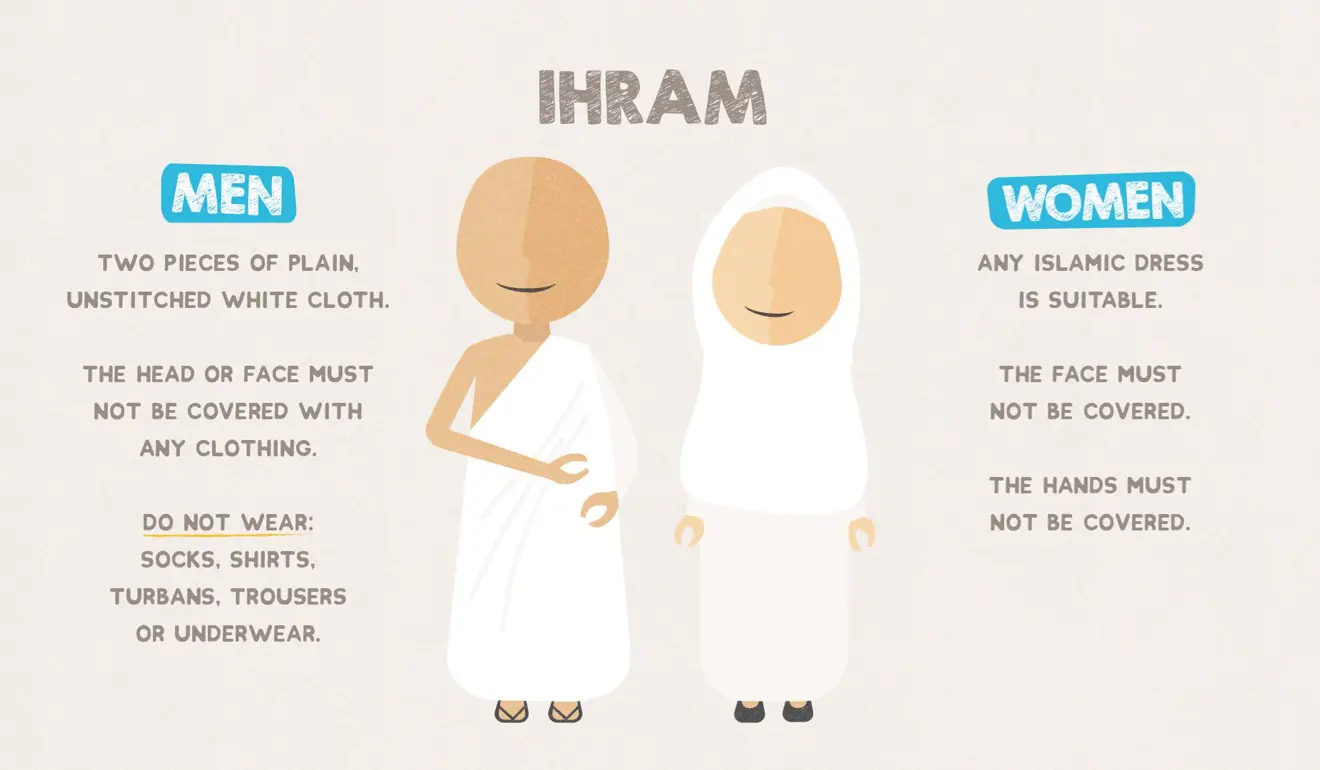
Both men and women must also observe the following rules for Ihram:
To summarise - so far, you have passed over the Meeqat, made the intention to begin your Hajj and entered into a state of Ihram. The Ihram is a state of mind and, just like when you begin praying or fasting, certain things which would ordinarily be halal for you are now haram. It is important to maintain this state of mind as you proceed through the next steps. If you are still unsure about how to wear Ihram, check out our step-by-step guide.
Tawaf - the ritual of circulating the Ka’bah seven times on Hajj and Umrah.
Before beginning the Tawaf:
Men should wear their Ihram so that their right shoulder is bare. This is known as Idtiba’a. Men need to cover their shoulder again after their Tawaf is complete (i.e. after seven tawafs).

Simple, right? Just a couple more things to note:
The Tawaf you are performing is known as Tawaf Al-Ifadah, and to complete it, you must pray at Maqam Ibrahim and drink Zamzam water.
After completing Tawaf, go towards Maqam Ibrahim reciting this ayah:

And remember when We made the Sacred House a centre and a sanctuary for the people saying, “You may take the standing-place of Ibraham as a site of prayer.” And We entrusted Ibraham and Ismail to purify My House for those who circle it, who meditate in it, and who bow and prostrate themselves in prayer.
[The Noble Qur'an, 2:125]
Stand so the Maqam Ibrahim is between you and the Ka’bah. Don’t try to stand directly in front of it - it will be far too crowded. Anywhere in Al-Masjid Al-Haram is fine, as long as the Maqam is between you and the Ka’bah.
Pray two rakats. It is recommended to recite Surah Kafiroon in the first rakat and Surah Ikhlas in the second rakat (after Surah Fatihah, of course).
What must you do after praying at Maqam Ibrahim?
Although this seems like a lot to remember, the steps are actually fairly simple once you’ve memorised them. To summarise - previously, you entered into the state of Ihram. You have now circled the Ka’bah seven times while making du’a, you have prayed two rakat and you’ve drunk Zamzam water.

Sa'ee is walking or running between the two hills of Safa and Marwah seven times to commemorate Hajar's (as) search for water for her son Isma'il (as)
And that’s it! Sa’ee is completed after seven rounds, so you will end at Marwah. You have now completed the first part of Hajj, which is the same as ‘Umrah. If you are doing Hajj Tamattu’ (this is what the majority of pilgrims perform) is time to end your Ihram.
For men, this means trimming or shaving the hair on their head and changing from Ihram clothes to normal clothes. For women, this means trimming their hair by a fingertip. Then the state of Ihram is ended and the rules of Ihram are lifted.
If you were performing ’Umrah, you have now completed it.
To summarise part one of your Hajj - you begin Ihram at the Meeqat, you perform Tawaf, you pray two rakat, you drink Zamzam water, you perform Sa’ee and you end your Ihram. Note that menstruating women can’t do Tawaf or pray, but they can take part in other parts of the pilgrimage.
You are now free to worship in Al-Masjid Al-Haram until the 8th of Dhul Hijjah.
We’ve put together a list of essential du’as to memorise for Hajj for you to check out. Or go to part two of the Hajj guide to see the steps you must perform from 8th Dhul Hijjah onwards. You can also watch our Hajj documentary series The Prophetic Steps, filmed in Makkah, to learn more about the different steps of Hajj, including the history of the Ka’bah itself.
Muslim Hands is an award-winning charity, established in 1993 to help those needing emergency relief and tackling the root causes of poverty. Find out more about us and the way we use your Sadaqah and Zakat.
Support our bakeries in Yemen and Syria

Help us preserve Islam's third holiest site